Who owns SpaceX — and who controls it?
From a dense network to focused questions about economic interests, governance and indirect holdings.
An image is worth a thousand words. Tisserand keeps the thousand words behind it.
Questions this case answers
- Who controls SpaceX, beyond who owns its shares? Capital structure · Formal roles and powers
- Who are the influential players and the intermediaries between groups? Power players · Middlemen and bridges
- How are the key people connected, and through which channels? Connections between key people
01 / Begin with the documentary corpus
Prepare your documents for Tisserand shows the documentary starting point: saved company filings, ownership disclosures, court records and reporting. Tisserand does not read these files itself: entities and relationships were extracted from them outside Tisserand, with an AI following our extraction prompts, then opened in Tisserand as a map.
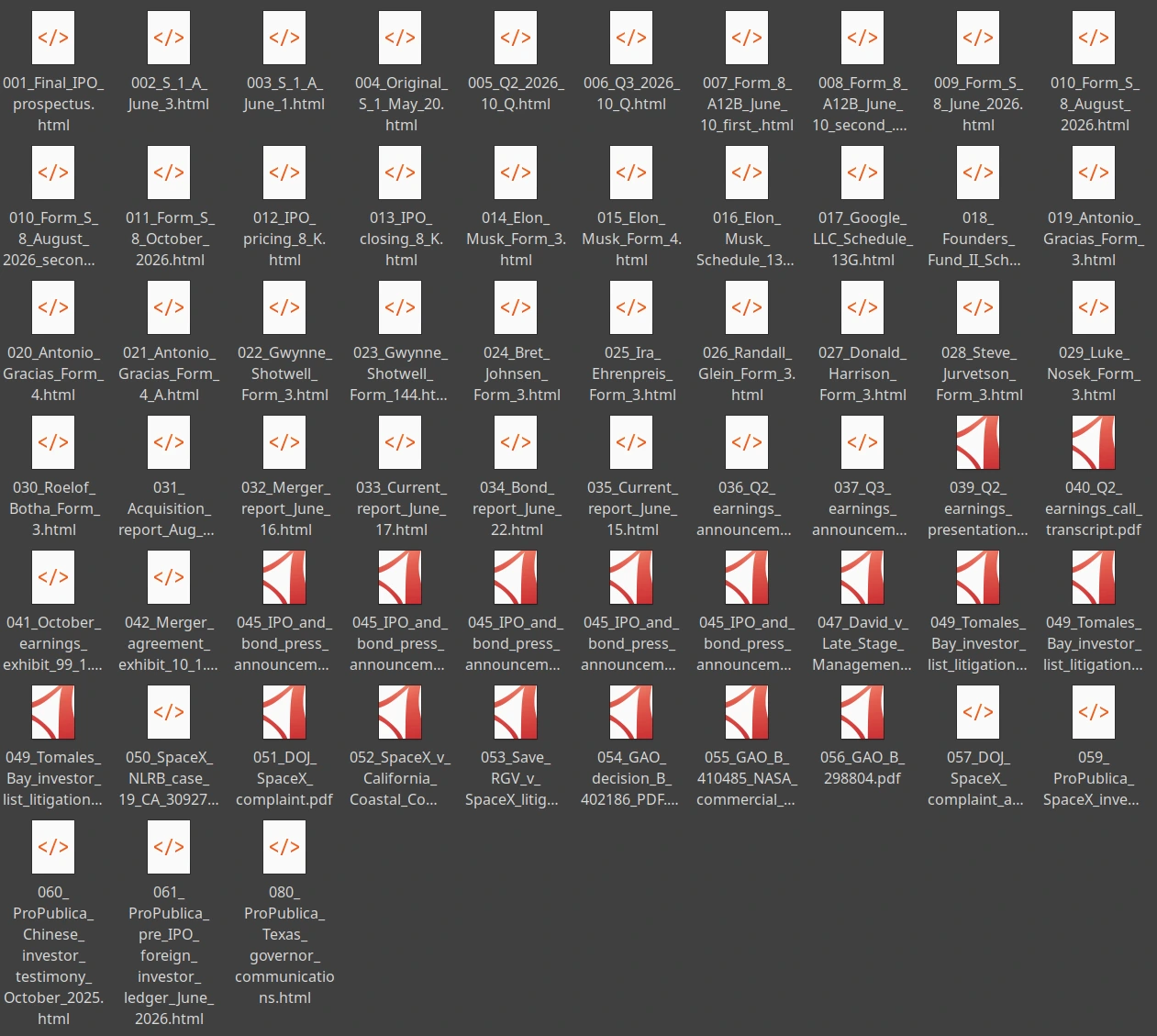
02 / See the whole network
An ownership investigation starts with a difficult reading task: connect people, companies, securities and governance provisions across a substantial documentary corpus.
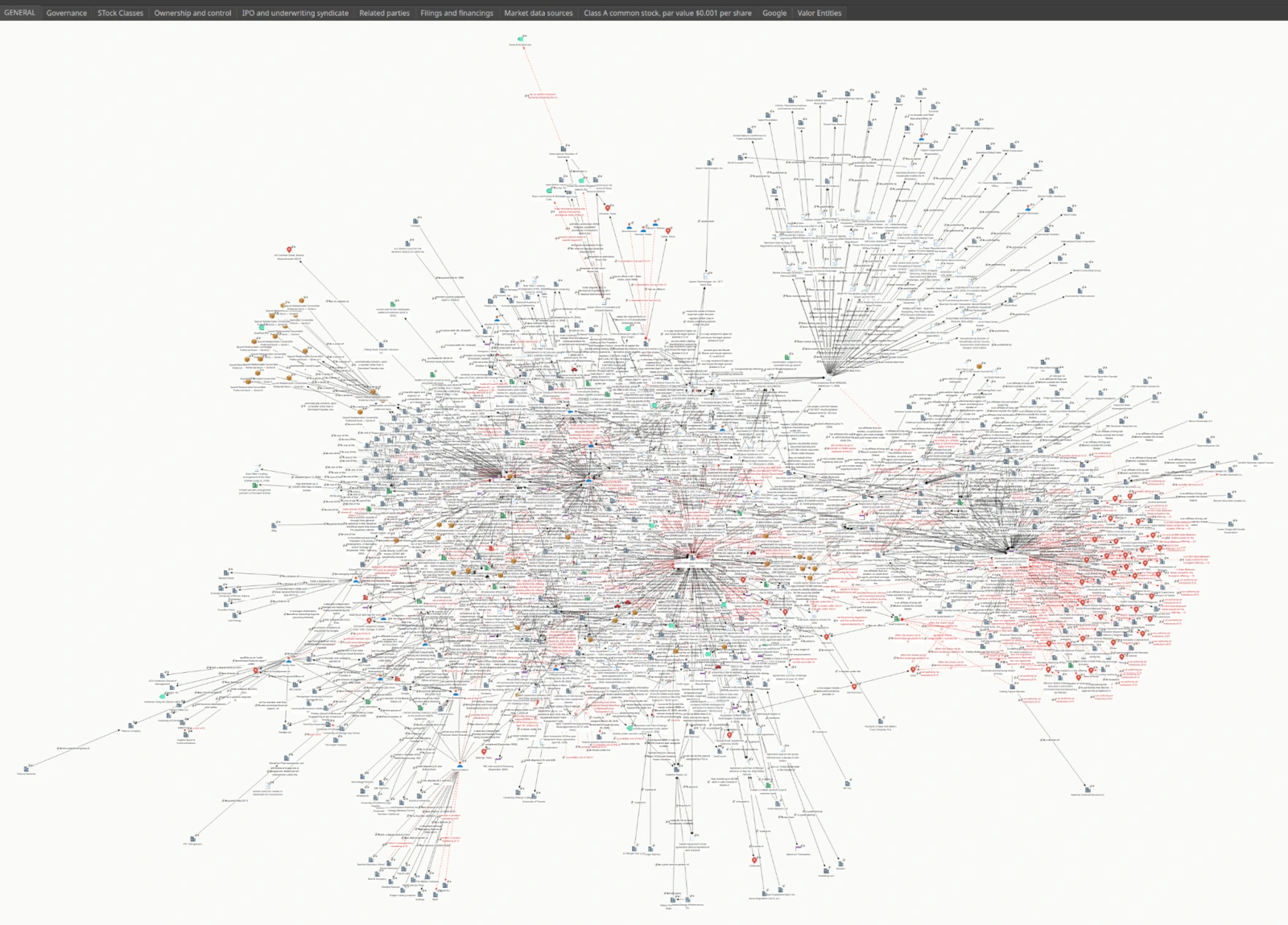
The sequence begins with General Graph 600 entities, 1200 links. The image shows why the analyst needs focused views rather than one exhaustive chart.
03 / Identify Power Players
identification of central entities highlights selected nodes within the full graph. This gives the analyst a practical starting point for reviewing the most connected parts of the model. Tisserand offers degree, betweenness and closeness centrality to explore different aspects of network structure.
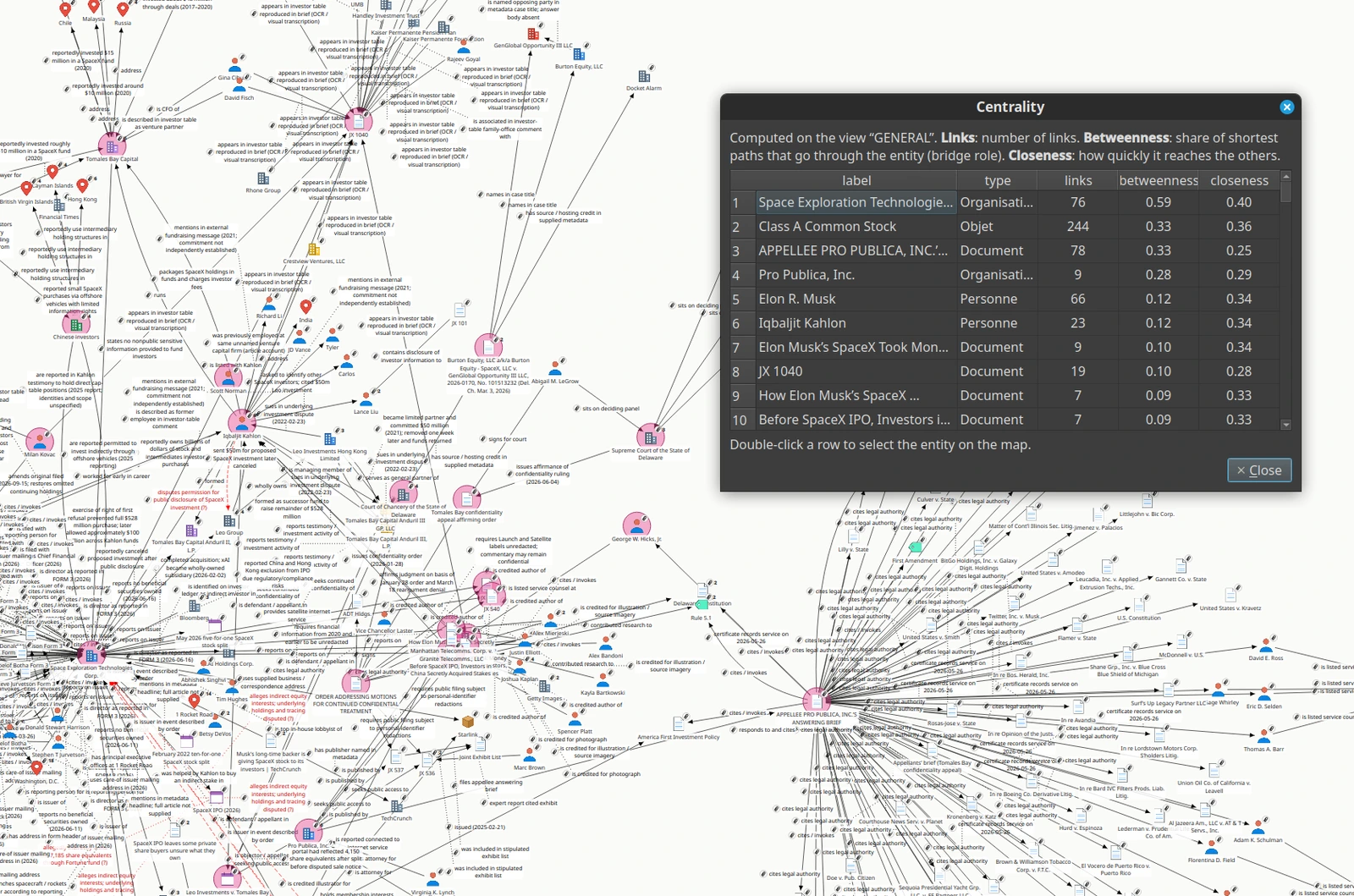
Analytical value: move from an undifferentiated network to a shortlist of entities to examine.
04 / Map Communities
Identification of communities introduces coloured groupings across the network. These groupings help the analyst locate coherent areas of the graph and choose where to investigate next.
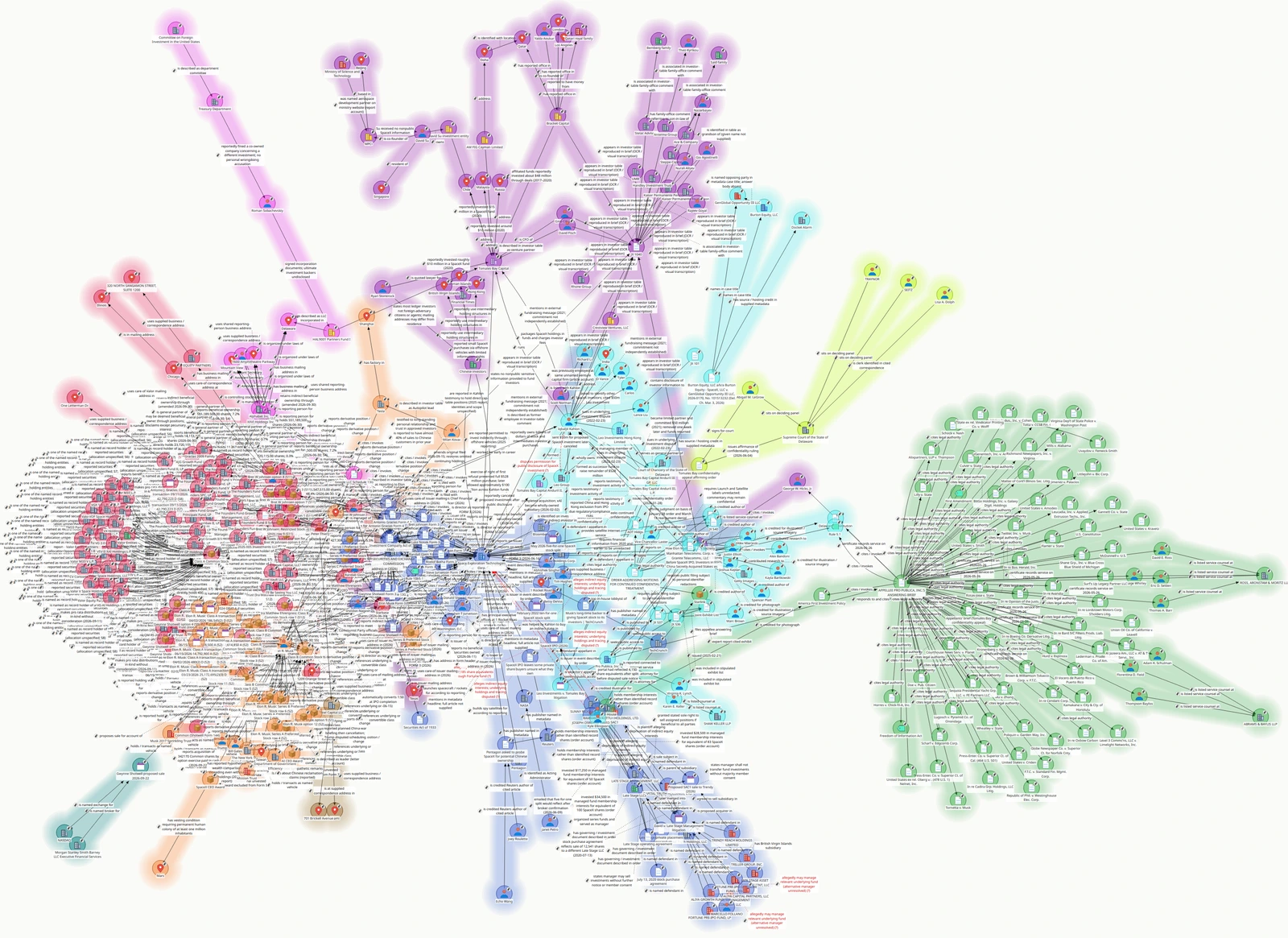
The next task is to interpret each cluster against its entities and source material. A community is a structural grouping; it does not by itself establish a legal group or coordinated conduct.
Analytical value: break a large investigation into manageable lines of enquiry.
Colours describe the displayed graph partition. No community-detection algorithm is asserted here.
05 / Identify Middlemen and Bridges between Communities
Identification of bridge entities that connect communities draws attention to highlighted connections spanning different areas of the graph. Pivot entities and bridge links provide complementary ways to examine connections across the network.
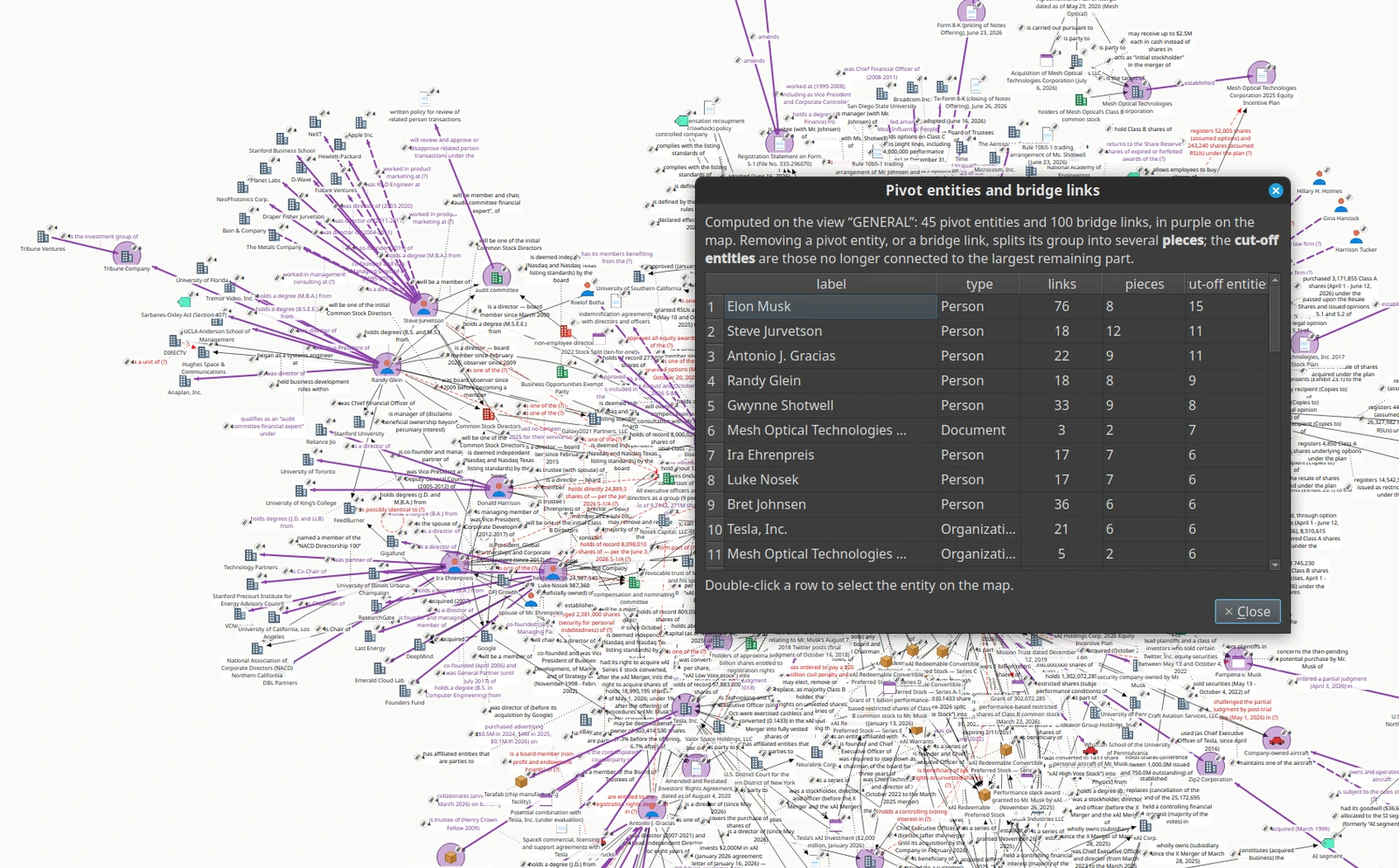
Each bridge becomes a question to check, rather than a conclusion about influence.
Analytical value: identify paths that a review of isolated clusters could miss.
06 / Understand the capital structure
Classes of Stock narrows the investigation to securities and their relationships. The focused view separates common and preferred instruments and displays conversion and authorisation relationships.
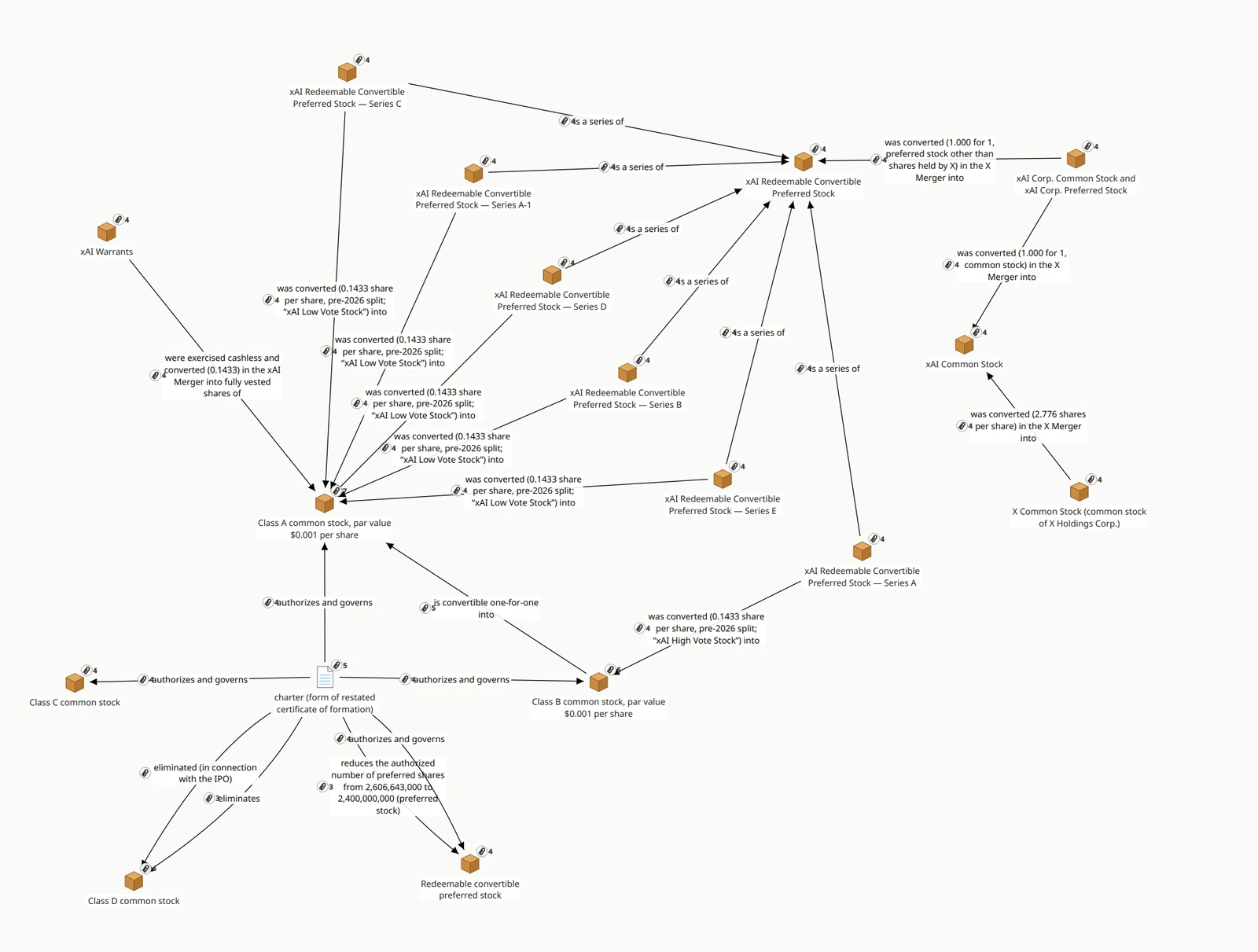
This is a necessary step before interpreting a holding: an economic interest, a conversion right and a voting entitlement answer different questions. The relevant instrument and reporting date must remain explicit.
07 / Dig deeper and inspect detailed relationships
Class A Common Stock follows a single instrument into its surrounding network of holders, documents and other relationships.
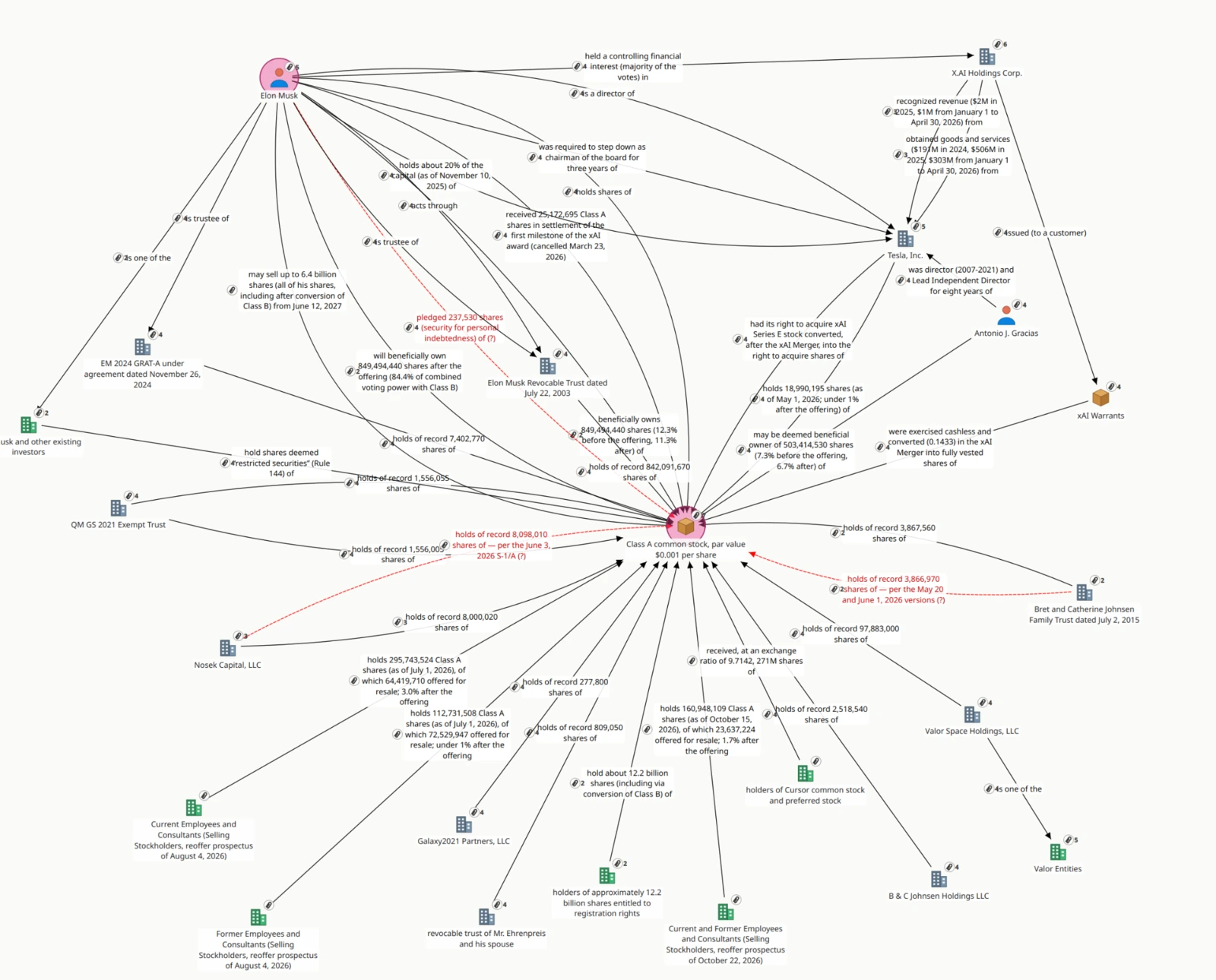
The analyst can review each connection separately and distinguish holdings from transactions, reporting contexts and rights. Repeated references to the same shares must not be added as separate economic interests.
Analytical value: replace a broad capital-structure view with a targeted examination of one share class.
Red links represent hypotheses in this example. Black links are marked as established in this example; verify each against its dated source.
08 / All supporting evidence is at your fingertips
All source documents attached pairs a focused graph with an open properties panel. The selected instrument has source extracts and four attached filing documents visible.
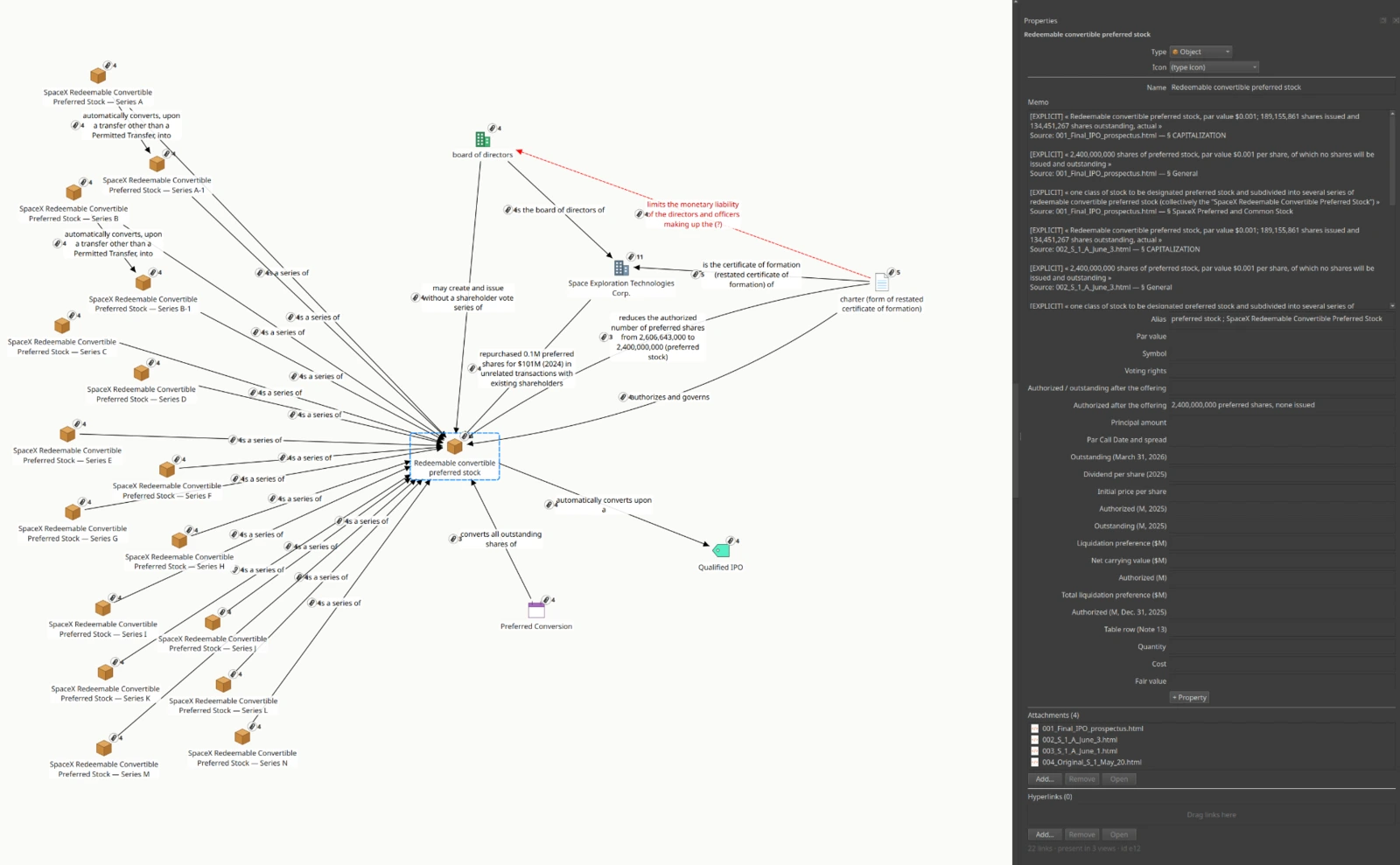
When you select an entity or a link, you have immediate access to all attached source documents in the properties panel. It is information at your fingertips. Source documents are copied into the map file, so the map travels with its evidence.
Analytical value: analysts gain credibility when they can immediately display the supporting evidence for their findings.
09 / Review formal roles and powers
Board of Directors focuses on directors, committee membership and associated governance relationships. Elon Musk appears within this wider structure rather than as an isolated node.
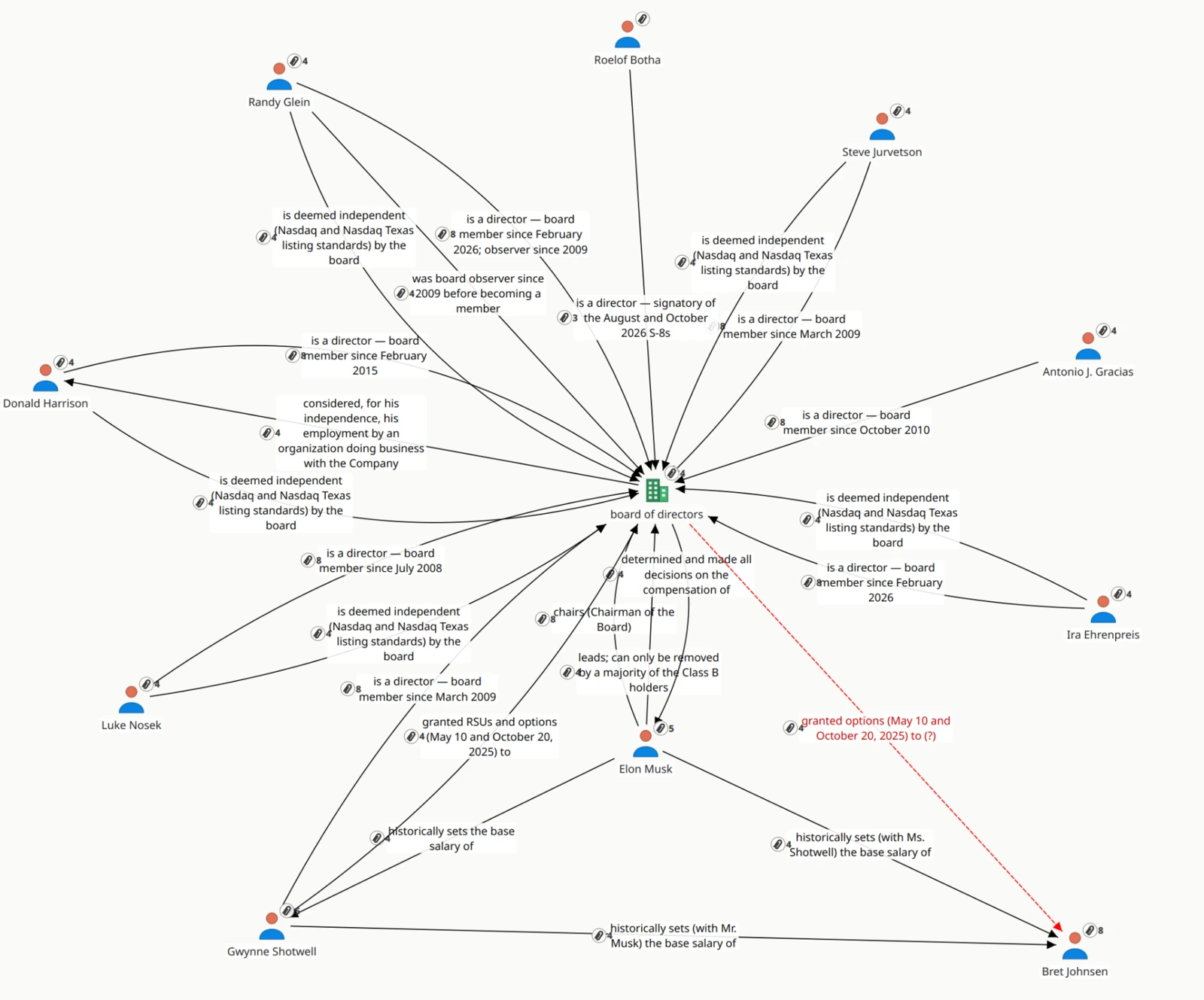
The graph includes dated and uncertain relationships. These should remain qualified in any published finding.
10 / Understand a key shareholder
Analysis of a key person centres on Antonio J. Gracias and connects board roles, business affiliations, holdings and institutional relationships. Elon Musk appears through shared corporate contexts.
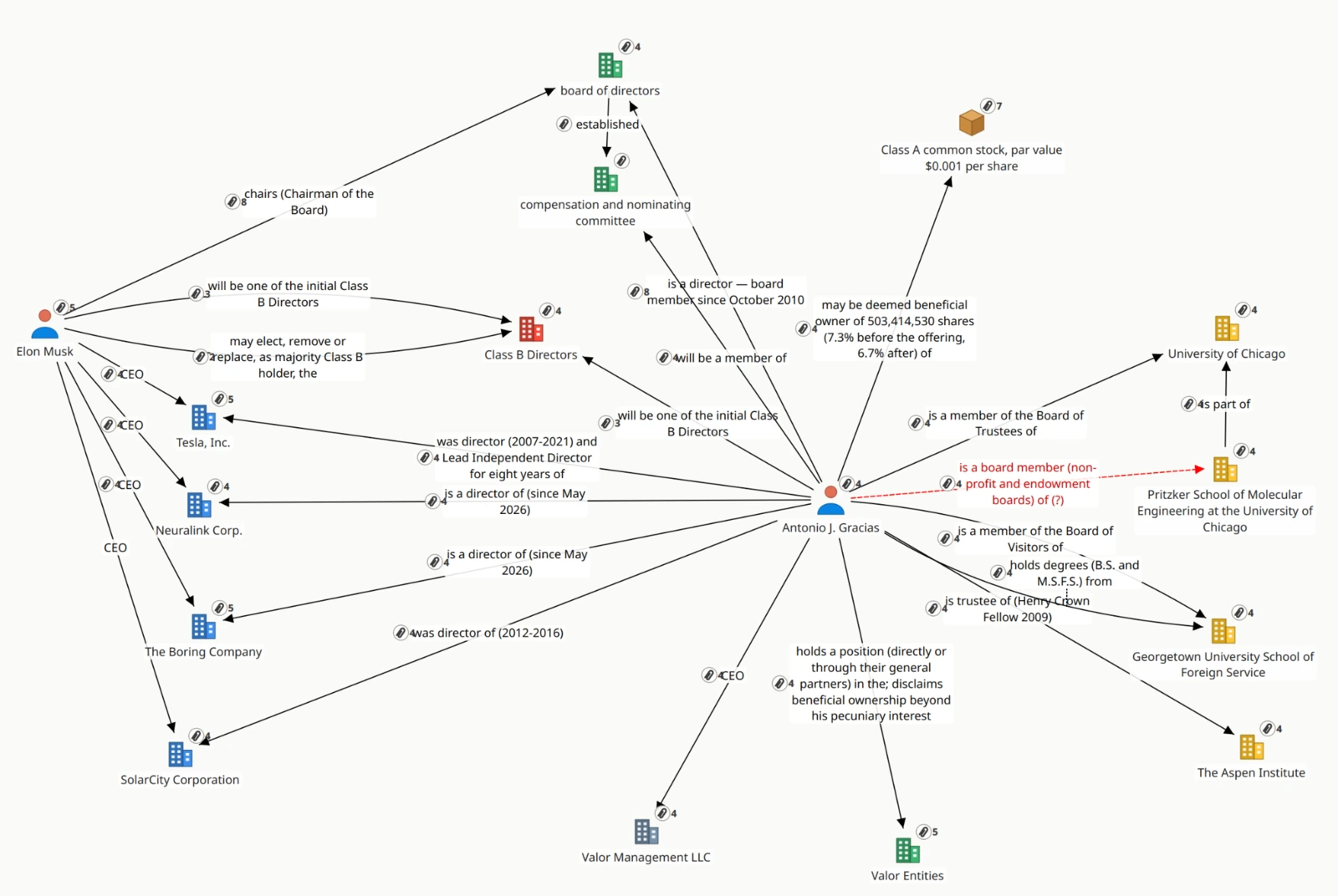
This view helps the analyst compare overlapping roles while preserving their different meanings. A historical directorship, a reported interest and an institutional affiliation should not become a single assertion of influence.
The red dashed relationship is expressly uncertain in the supplied image and is not adopted as a finding.
11 / Analyze a key investor
Analysis of a key entity centres on Tomales Bay Capital. Mr. Iqbaljit Kahlon facilitated indirect investment in SpaceX by investors whose capital originated in China. The view brings reported fund investments into one focused image.
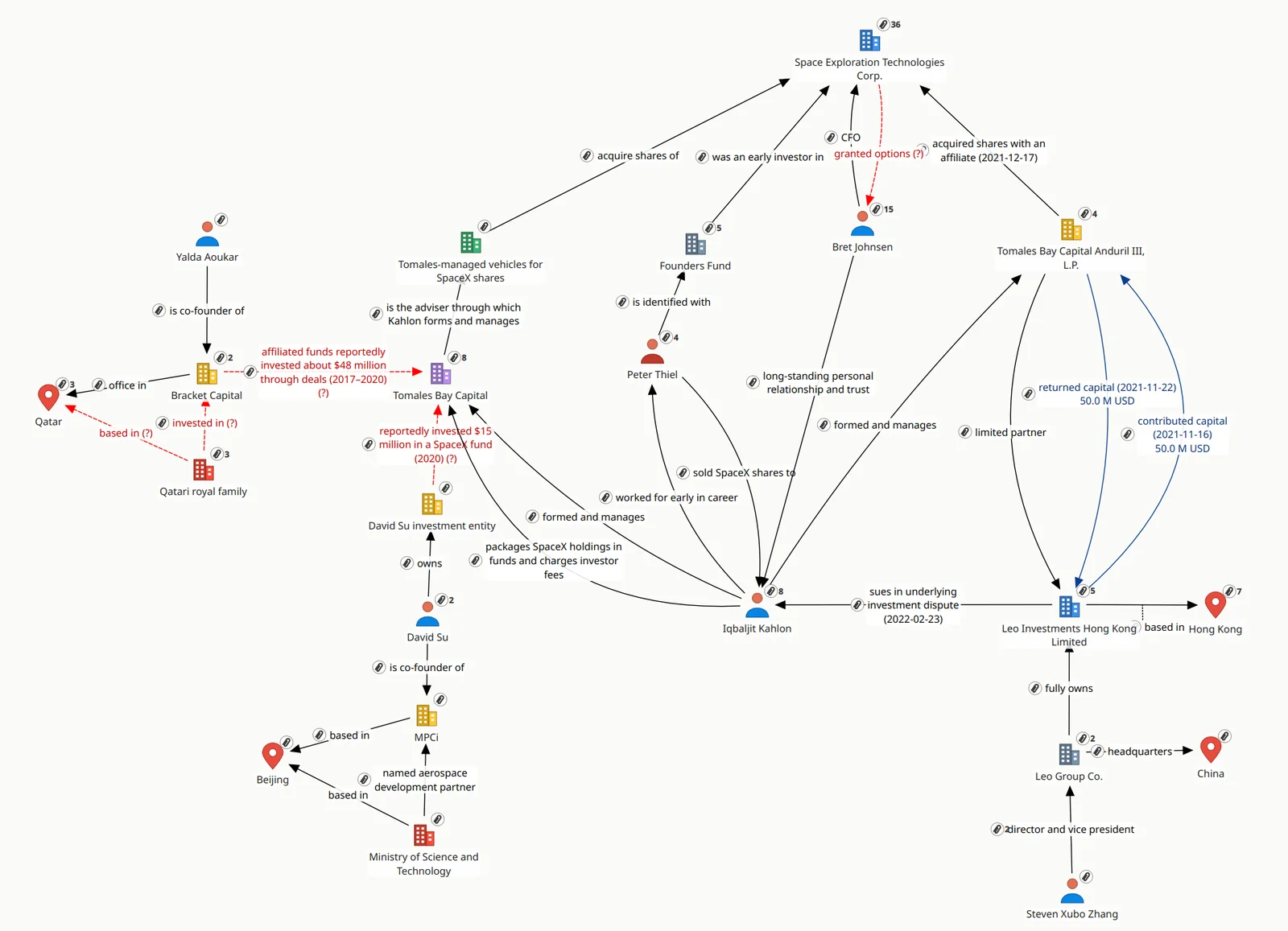
The analyst distinguishes a reported investment through a fund from a direct holding in SpaceX. Each relationship retains its own source wording and date; geographic or professional associations alone do not establish ownership or control.
12 / Visualize connections between key people
Perform Shortest Path Analysis to understand lobbying and influence channels, alliances and oppositions: compare the shortest paths between two selected entities, then review the evidence behind each link.
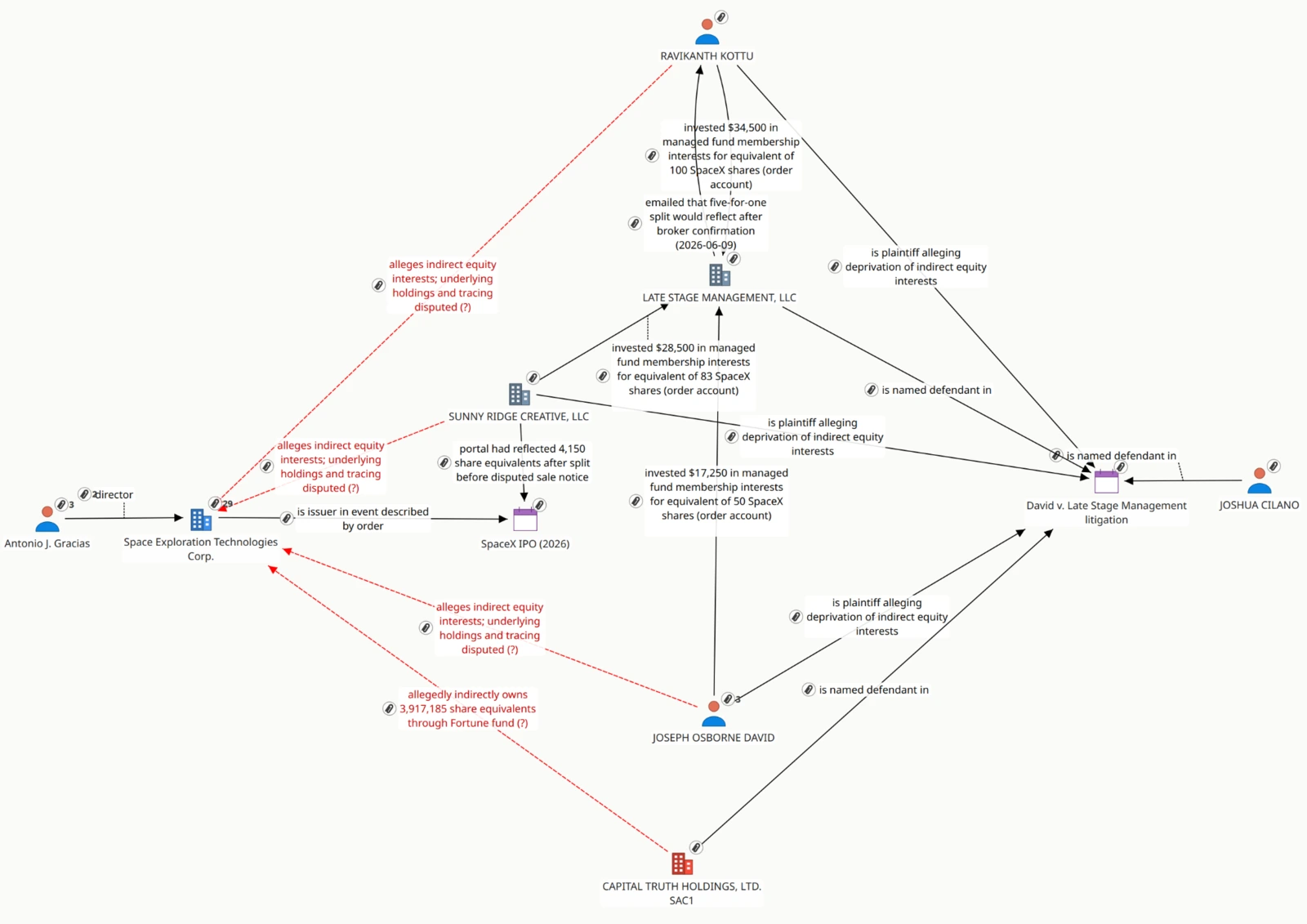
Several links are expressly disputed allegations. The analyst must preserve that distinction and inspect the underlying records before drawing a conclusion.
You are in control. Tisserand is just a tool with a proposed workflow. You pilot the analysis
Your data stays private. The extraction of entities and relationships is done by your own approved AI tools, with the help of Tisserand's curated extraction prompt. Tisserand runs offline, with no telemetry, and your maps can be protected with a password (AES-256 encryption).
Map the relationships behind your own market question.
Discuss your evidence, analytical questions and the views you need to communicate.
Contact Tisserand: hello@tisserand.app